
From around the 9th to the 16th century, Arab merchants crossed the seas to reach the east coast of the African continent. Remnants of the era they built can still be seen today in countries like Kenya and Tanzania. One of the most iconic locations is Zanzibar, an island in Tanzania floating in the Indian Ocean. It is an island that once flourished as a center of the slave trade.
Characterized by its stone buildings constructed from coral stone, Zanzibar is commonly known as “Stone Town.” In 2000, it was designated as a UNESCO World Heritage site. In the narrow, winding alleys, buildings that blend Islamic and European styles stand side-by-side. The Arabesque wood-carved doors, known specifically as “Zanzibar Doors,” are particularly distinctive; simply strolling around in search of these beautiful doors is a delight in itself.

These beautiful decorations are legacies left behind by the merchants who prospered in this land. Some are still used as inns or residences, while many others have become ruins or historical sites, allowing visitors to see remnants of that era throughout the island. Walking the streets, you will see people dressed in Islamic attire, and in the mornings and evenings, the sounds of the Quran—”Allaaahu…”—resonate.
During prayer times, you can witness people offering prayers toward Mecca. People enjoying chai or water pipes (hookahs) are a common sight everywhere. In the markets, various types of spices and teas are sold, filling the air with an exotic fragrance.
At roadside stalls, you might even find Indian samosas for sale.
The elements of the Islamic world are strong, and there is also a scent of Europe due to the influence of the colonial era. 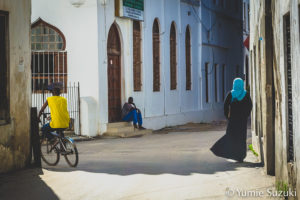
Furthermore, because many Indian immigrants arrived during the British colonial period, Indian elements can also be seen. Is this Arabia, India, or Africa? No—it is the fusion of all these diverse elements that created what is truly Swahili culture. Zanzibar is accessible from Dar es Salaam via a 1.5-hour high-speed boat or a 3-hour ferry.
By plane, it is just 30 minutes from Dar es Salaam. Divers and travelers from all over the world gather here, drawn by the beautiful blue sea and white coral reefs. While the crystal-clear blue waters and relaxing on the beach are part of Zanzibar’s charm, if you visit this land, it is highly recommended to explore the island and immerse yourself in Swahili culture.